Towards
Plant Predictome
digital twins of developing organs
Foundations

The Single-cell root Atlas
- Shahan, R.*, C.-W. Hsu*, T.M. Nolan, B. Cole, I. Taylor, L. Greenstreet, S. Zhang, A. Afanassiev, A. Hendrika C. Vlot, G. Schiebinger, P.N. Benfey, and U. Ohler. (2022). A single-cell Arabidopsis root atlas reveals developmental trajectories in wild-type and cell identity mutants. Developmental Cell 57 (4), 543-560. e9 https://doi.org/10.1016/j.devcel.2022.01.008.
- Hsu, C.-W., R. Shahan, M. Nolan, P.N. Benfey, and U. Ohler. (2022). Protocol for fast scRNA-seq raw data processing using scKB and non-arbitrary quality control with COPILOT. STAR Protocols 3, 101729. https://doi.org/10.1016/j.xpro.2022.101729.
- Nolan, T.M.*, Vukasinovic*, C.-W. Hsu*, J. Zhang, I. Vanhoutte, R. Shahan, I. Taylor, L. Greenstreet, M. Heitz, A. Afanassiev, P. Wang, P. Szekely, A.Brosnan, Y. Yin, G. Schiebinger, U. Ohler, E. Russinova and P.N. Benfey. (2023). Brassinosteroid gene regulatory networks at cellular resolution in the Arabidopsis root. Science. https://doi.org/10.1126/science.adf4721.
- Vukašinović N.*, C.-W. Hsu*, M. Marconi, S. Li, C. Zachary, R. Shahan, P. Szekley, Z. Aardening, I. Vanhoutte, Q. Ma, L. Pinto, P. Krupař, N. German, J. Zhang, C. Simon, J. Perez-Sancho, P. C. Quijada, Q. Zhou, L.R. Lee, J. Cai, E.M. Bayer, M. Fendrych, E. Truernit, Y. Zhou, S. Savaldi-Goldstein, K. Wabnik, T.M. Nolan, E. Russinova (2025). Polarity-guided uneven mitotic divisions control brassinosteroid activity in proliferating plant root cells. Cell 188 (8), 2063-2080. e24. https://doi.org/10.1016/j.cell.2025.02.011.

The rice single-cell root atlas
- Zhu M.*, C.-W. Hsu*, L.L. Peralta Ogorek, I.W. Taylor, S. La Cavera, D.M. Oliveira, L. Verma, P. Mehra, M. Mijar, A. Sadanandom, F. Perez-Cota, W. Boerjan, T.M. Nolan, M.J. Bennett, P.N. Benfey, B.K. Pandey (2025). Single-cell transcriptomics reveal how root tissues adapt to soil stress. Nature 642, 721–729. https://doi.org/10.1038/s41586-025-08941-z
Observe, perturb, generalize
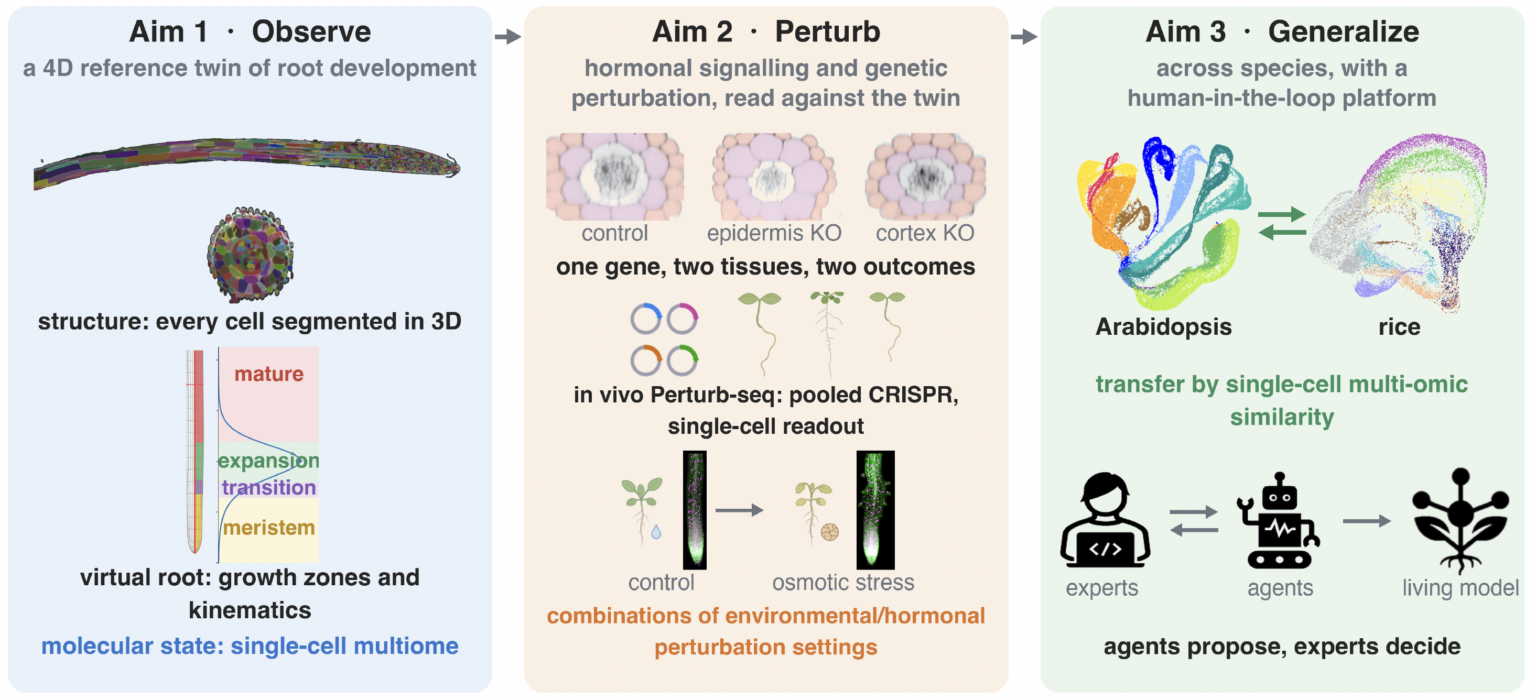
I have three complementary research aims:
Observe. A 4D reference twin of root development: 3D cell geometry, growth kinematics, and single-cell multiome state registered on one coordinate system. PHYTOMap gives cellular morphology in intact tissue; a 480-probe Xenium panel gives gene throughput.
Perturb. Hormonal, environmental, and genetic perturbations read against the twin: brassinosteroid signaling, osmotic stress, salinity, and soil compaction, then in vivo Perturb-seq with GeneSys prediction in an active-learning loop that proposes the next experiment.
Generalize. Knowledge transfer anchored in DNA and protein sequence and benchmarked on Arabidopsis and rice, so that regulators found in a model plant become entry points for roots that keep growing in drying and compacted soil, in rice first, then tomato, soybean, and maize.

Agentic AI powered Predictome
All three aims (Observe, Perturb, Generalize) depend on continuously assembling, curating, and comparing heterogeneous data, from microscopy volumes to genomes. Drawing on the digital twin design, cooperating AI agents integrate data across imaging, sequencing, and public repositories, place it in the coordinate system of the twin, and keep models current as new data arrive, while every interpretation keeps its provenance. Agents propose; experts decide. Delivered as shared, documented resources, the platform lowers the barrier to computational discovery across the plant community.